
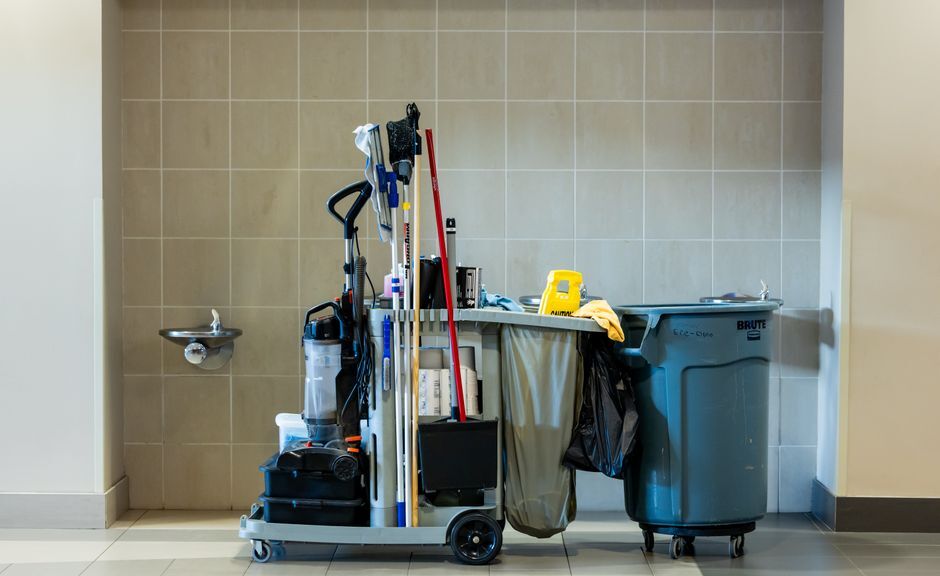
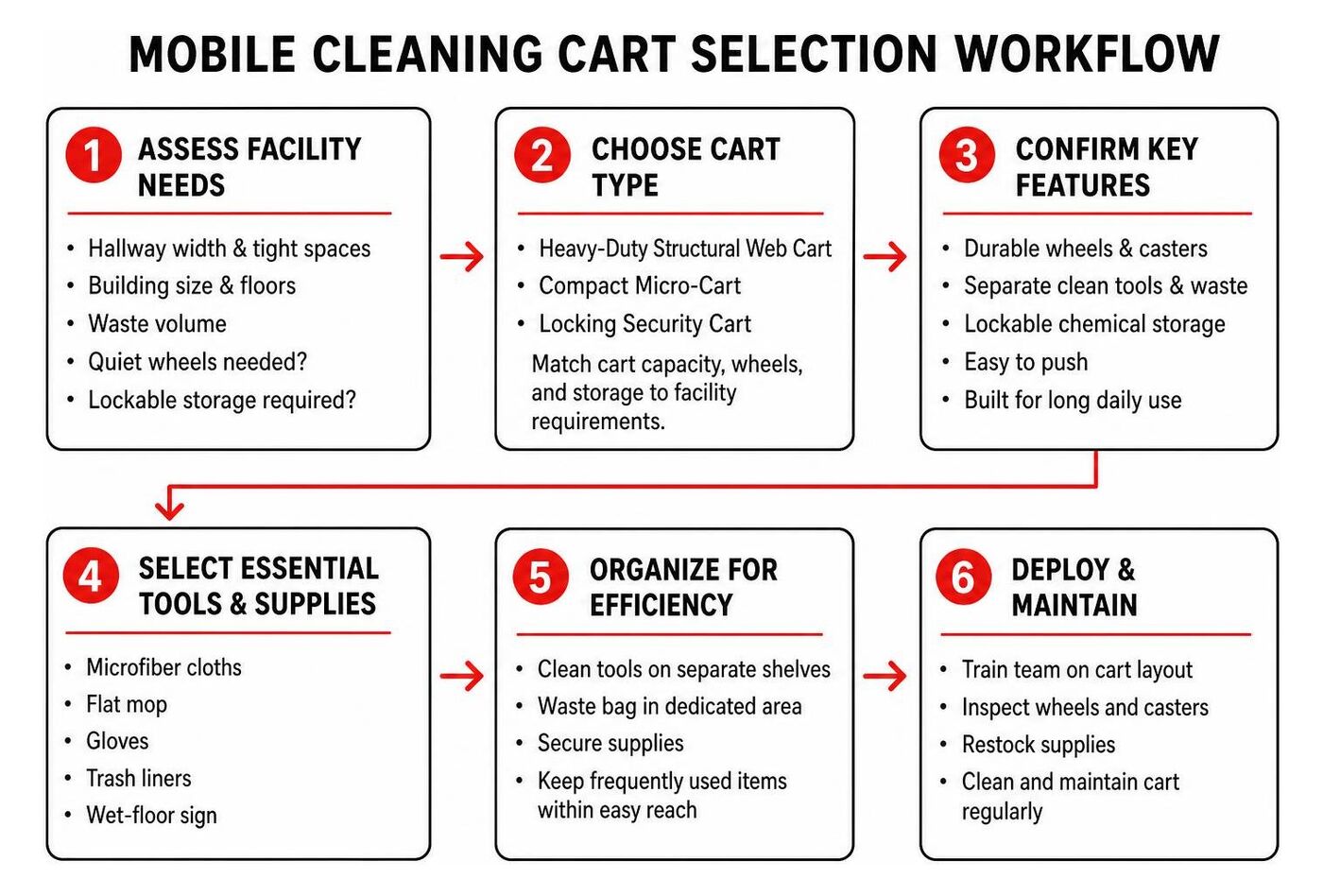
For a commercial cleaning janitor, the best starting setup is a cart that fits the building's hallways, carries supplies securely, and is easy to push. Look for durable wheels, separate space for clean tools and waste, and room for microfiber cloths, a flat mop, gloves, trash liners, and a wet-floor sign. In healthcare or other sensitive areas, prioritize quiet wheels and lockable chemical storage.
The right cart is a mobile workstation, not just a place to hold supplies. This guide compares cart types and the tools worth carrying so you can choose a setup that suits your facility and budget.
I'm Richard Raj, owner of Office Care Inc. Since 1997, I've led commercial cleaning janitor programs for offices, schools, healthcare, and government facilities across Maryland, Washington, D.C., and Virginia.
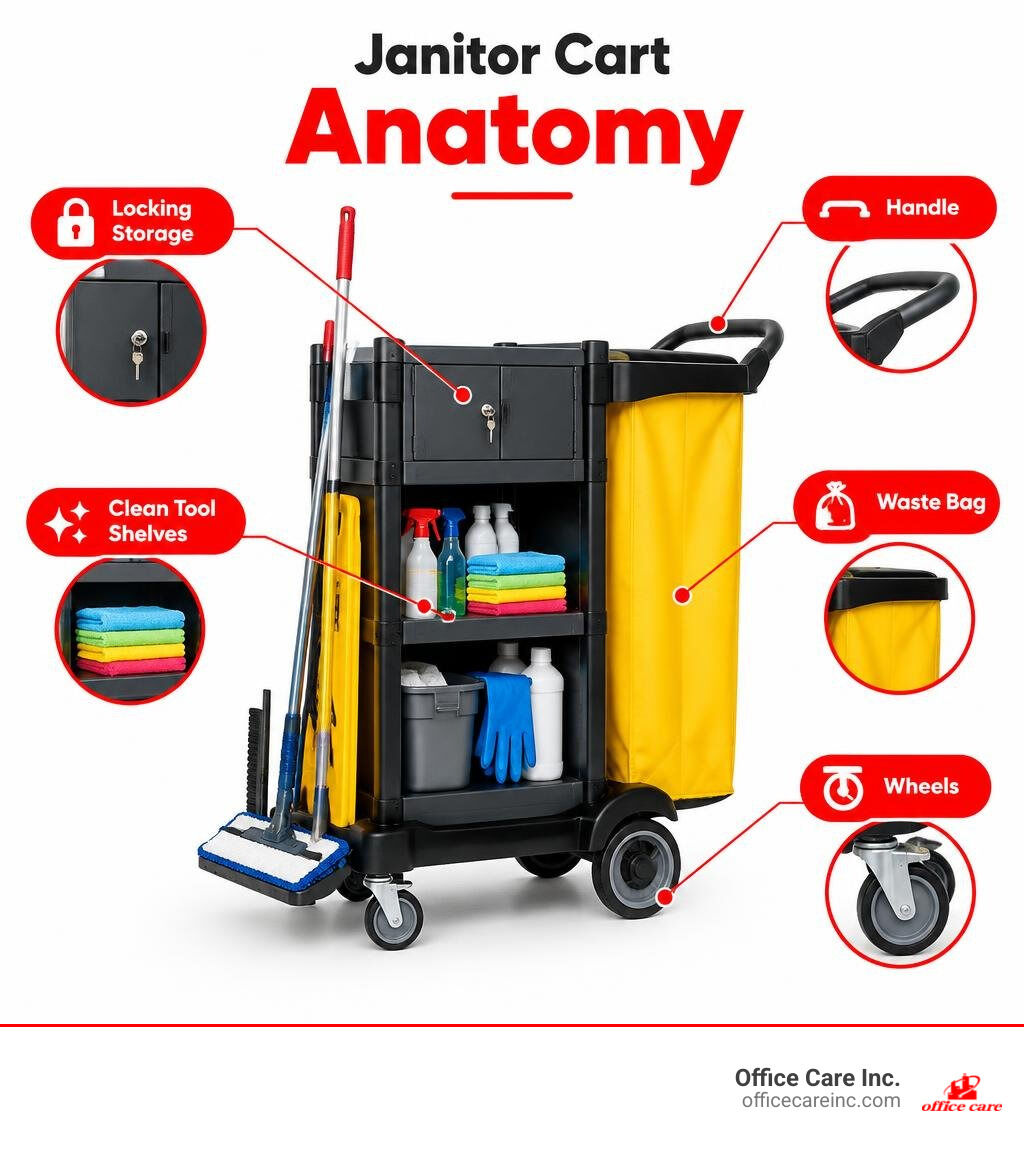
Core Types of Mobile Janitorial Carts and Stations
Selecting the right mobile janitorial cart is the foundation of any streamlined custodial program. In commercial facilities, custodians walk miles each shift. Forcing your team to haul mismatched caddies or push wobbly, undersized trolleys wastes labor hours and causes physical strain.
Commercial carts are purpose-built workstations molded from high-density structural web plastic or structural foam. Unlike standard injection-molded plastic, structural foam integrates tiny internal air pockets surrounded by solid skins, yielding exceptional strength-to-weight ratios, dent resistance, and sound dampening.
| Cart Category | Primary Construction Material | Typical Payload Capacity | Wheel / Caster Configuration | Chemical Storage Type | Best Facility Applications |
|---|---|---|---|---|---|
| Heavy-Duty Structural Web Cart | High-density structural web polyethylene | 300 to 500 lbs | 8-inch non-marking rear wheels, 4-inch front swivel casters | Open tiers with optional clip-on caddies | Multi-tenant office buildings, schools, high-capacity venues |
| Compact Micro-Cart | Reinforced polypropylene & aluminum uprights | 150 to 250 lbs | 4-inch to 5-inch all-swivel quiet casters | Integrated lockbox or recessed top trays | Tight footprints, boutique retail, multi-level historic offices |
| Locking Security Cart | Structural foam with fully enclosed cabinet doors | 300 to 400 lbs | Precision ball-bearing, non-marking TPR casters | Keyed or push-button locking doors and hood | Healthcare suites, daycare centers, government facilities |
High-Capacity Multi-Floor Mobile Carts
In expansive commercial properties, high-capacity carts serve as central replenishment hubs across long corridors. These systems feature heavy-duty vinyl or ballistic nylon collection bags (often 30 to 40 gallons) fastened with secure grommets. They handle massive loads of dry waste, compost, and collected linens without tearing.
To manage multi-floor transit, look for carts with non-marking 8-inch thermoplastic rubber (TPR) rear wheels and 4-inch ball-bearing front swivel casters. These ensure smooth movement over threshold transitions, elevator gaps, and carpet-to-tile borders. When servicing high-traffic zones, high-capacity units prevent continuous round trips to the custodial closet, preserving labor productivity.
Compact and Low-Noise Healthcare Carts
Healthcare clinics, medical office buildings (MOBs), and executive office wings demand absolute discretion and stringent infection prevention. Compact healthcare carts incorporate silent, sealed-bearing casters that glide over sheet vinyl and terrazzo without squeaking or leaving scuffs.
More importantly, healthcare-grade carts feature fully enclosed, lockable chemical hoods and cabinet doors. This locks away potent hospital-grade disinfectants from patients, visitors, and unauthorized personnel. For spaces requiring meticulous daily janitorial cleaning, these carts incorporate seamless, chemical-resistant polymers that withstand daily wipedowns using sodium hypochlorite, hydrogen peroxide, or quaternary ammonium solutions without degrading.
Multi-Tier Mobile Carts for the Commercial Cleaning Janitor
Multi-tier workstations offer the flexibility required across diverse commercial real estate portfolios. A three-tier structural foam cart provides distinct zoning:
- Top Tier: Quick-access tools, trigger spray bottles, clean microfiber wipes in organized caddies, and digital inspection logs.
- Middle Tier: Replenishment consumables, such as multi-fold hand towels, toilet tissue rolls, coreless rolls, and spare trash liners.
- Bottom Platform: Heavy payloads, including dual-bucket flat-mop setups, commercial floor scrubbers, or onboard backpack vacuum storage.
- Perimeter Attachments: Dedicated clips and brackets to lock wet-floor safety signs, dust mops, and extension poles securely to the cart exterior, keeping the primary work deck clear.
Essential Equipment Setup for the Modern Commercial Cleaning Janitor
An empty cart accomplishes nothing. Modern custodial operations prioritize speed, ergonomic safety, and cross-contamination prevention through systematically arranged commercial gear.
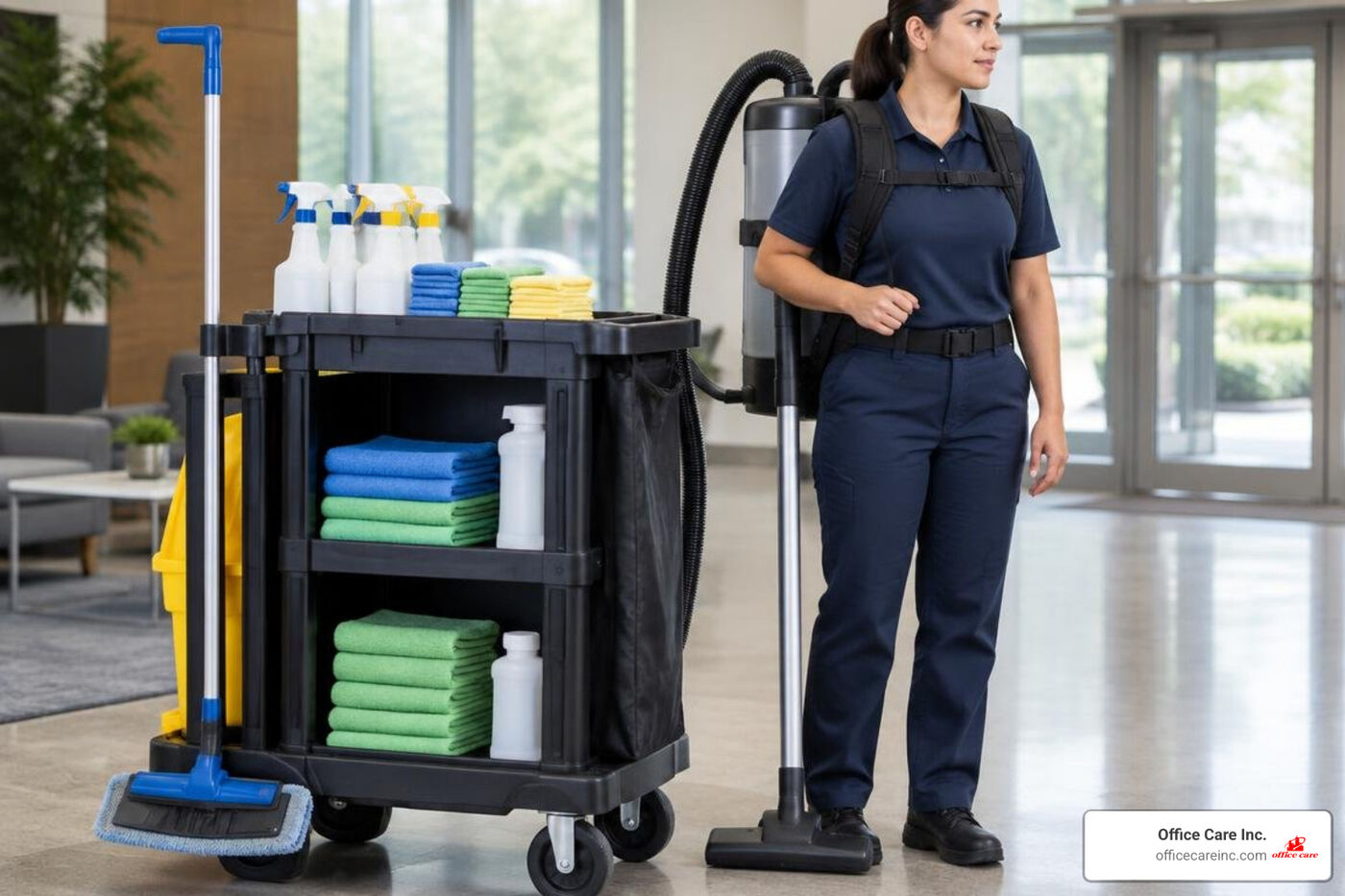
Every commercial cart should maintain a standardized inventory to handle both routine maintenance and unexpected spills without returning to the chemical dispensary:
- Surface Disinfectants: EPA-registered, hospital-grade broad-spectrum disinfectants (quaternary ammonium compounds or accelerated hydrogen peroxide) for high-touch point sanitization.
- Neutral Floor Cleaner: pH-neutral concentrated detergents (pH 6.5–7.5) formulated to lift soil without stripping protective wax or floor finishes.
- Heavy-Duty Degreaser & Glass Cleaner: Bio-based or Green Seal-certified formulas for streak-free mirrors, stainless steel fixtures, and breakroom countertops.
- Personal Protective Equipment (PPE): Nitrile chemical-resistant gloves, splash-resistant safety goggles, and slip-resistant shoe covers.
- Safety Data Sheet (SDS) Binder: A brightly colored, water-resistant binder or digital QR hub mounted directly to the cart handle, providing instant hazard data compliance for every chemical carried.
High-Efficiency Cleaning Tools for the Commercial Cleaning Janitor
Traditional loop string mops and cotton rags have given way to advanced synthetic microfiber systems. In the debate surrounding daily janitorial vs deep cleaning, equipping the daily janitorial cart with the right tools blurs the line, keeping properties at a deep-clean baseline continuously.
Modern carts utilize flat-mop microfiber frames featuring 16-inch to 24-inch pocket-style or hook-and-loop pads. Microfiber split fibers measure less than 1 denier (about one-hundredth the diameter of a human hair), mechanically capturing dust, biological matter, and microscopic soils rather than simply smearing them across surfaces. Pair these with four-color-coded wiping cloths:
- Red: High-risk restroom zones (toilets, urinals).
- Yellow: Secondary restroom surfaces (sinks, dispensers, partitions).
- Blue: General office spaces, desktops, conference tables.
- Green: Breakrooms, kitchens, and food-handling areas.
For overhead dust management, telescopic aluminum and carbon-fiber poles equipped with bendable microfiber sleeves allow technicians to safely clean ceiling vents, structural beams, and pendant lights from the floor, eliminating the need for step stools or ladders in busy hallways.
Floor Care Equipment and HEPA Extraction Systems
Indoor air quality directly impacts workplace wellness. Outdated upright vacuums often exhaust fine respirable dust back into the ambient breathing zone. Equipping janitorial carts with lightweight commercial backpack vacuums solves this challenge.
High-filtration commercial vacuums equipped with true HEPA filters capture 99.97% of airborne particulate matter down to 0.3 microns, including pollen, mold spores, and fine drywall dust. Backpack units cut vacuuming labor times by over 40% compared to traditional push vacuums by allowing natural arm-sweeping motions across carpet and hard-surface flooring. On the hard-floor side, dual-chamber mopping buckets isolate soiled rinse water from clean surfactant solutions, ensuring dirty water is never reapplied to freshly cleaned floors.
Key Evaluation Criteria: Ergonomics, Security, and Compliance
When outfitting a commercial janitorial fleet, purchasing decisions should balance upfront purchase costs against long-term physical ergonomics, building security, and regulatory mandates.
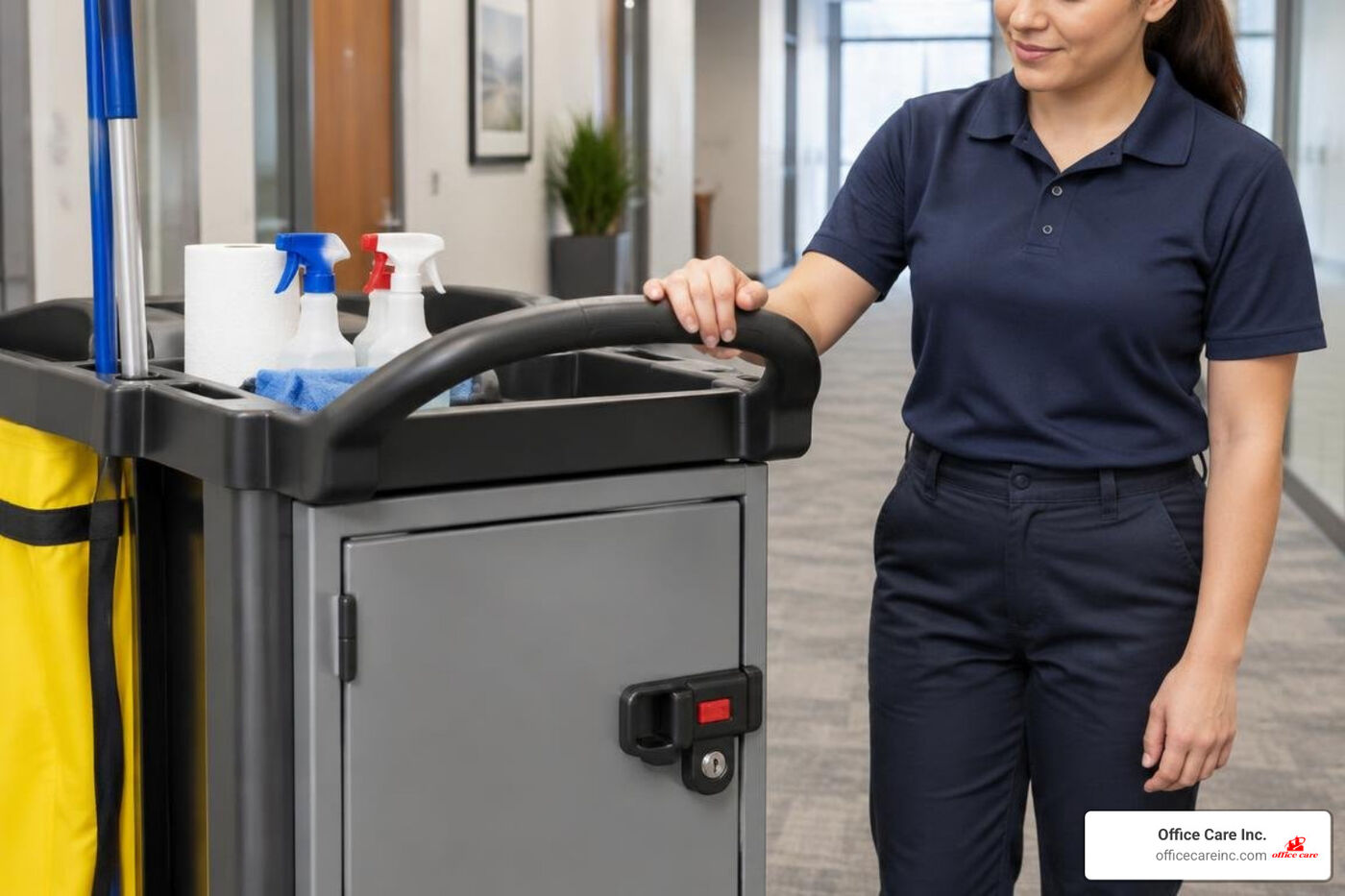
Ergonomics plays a crucial role in injury prevention. According to OSHA’s published ergonomic hospital and institutional guidelines, repetitive heavy pushing, pulling, and awkward bending represent primary causes of workplace musculoskeletal disorders among custodial staff. Look for commercial carts engineered with the following features:
- Multi-Position Ergonomic Handles: Contour-molded grab points that keep wrists in a neutral position, minimizing wrist strain regardless of operator height.
- Low Push-Pull Resistance: Precision industrial wheel bearings that require less than 5 pounds of initial breakaway force to move when loaded to maximum capacity.
- Locking Chemical Security: Tamper-evident cabinets that keep concentrated chemicals out of reach in public spaces, meeting OSHA hazard communication and local municipal health requirements.
- Green Seal and Eco-Standard Alignment: Modern commercial facilities heavily prioritize sustainability. Outfitting carts with reusable, ultra-low-moisture microfiber pads and concentrated dispensing bottles helps operations achieve Green Seal standards, cutting water and chemical waste by up to 95% compared to legacy cleaning methods.
Balancing these factors helps facility managers establish clear baselines for how often an office should be cleaned while maintaining consistent, audit-ready standards across all shifts.
In-House Equipment Investment vs. Outsourcing Janitorial Operations
Procuring commercial-grade janitor carts, HEPA extraction vacuums, auto-scrubbers, and inventory management systems requires a clear understanding of the Total Cost of Ownership (TCO). While buying equipment outright seems straightforward, facility executives often discover hidden lifecycle costs:
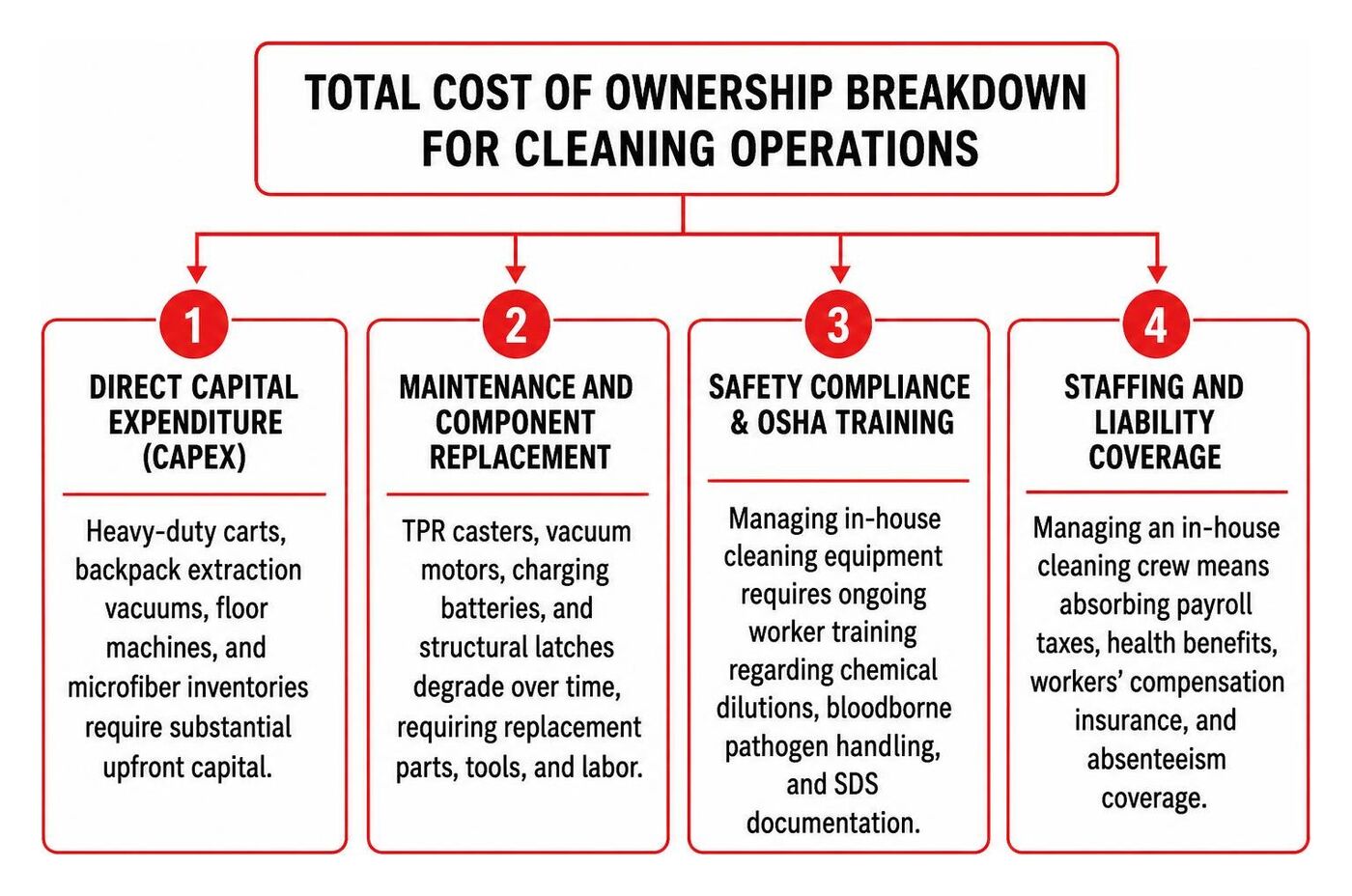
- Direct Capital Expenditure (CapEx): Heavy-duty carts, backpack extraction vacuums, floor machines, and microfiber inventories require substantial upfront capital.
- Maintenance and Component Replacement: TPR casters, vacuum motors, charging batteries, and structural latches degrade over time, requiring replacement parts, tools, and labor.
- Safety Compliance & OSHA Training: Managing in-house cleaning equipment requires ongoing worker training regarding chemical dilutions, bloodborne pathogen handling, and SDS documentation.
- Staffing and Liability Coverage: Managing an in-house cleaning crew means absorbing payroll taxes, health benefits, workers' compensation insurance, and absenteeism coverage.
For organizations looking to streamline operations, partnering with a specialized contract partner removes the burden of equipment acquisition, maintenance, and training. Contract cleaning professionals arrive on site fully equipped with cutting-edge, commercial-grade tools, EPA-approved chemicals, and trained technicians, converting unpredictable capital expenses into predictable operating budgets.
Frequently Asked Questions About Commercial Janitorial Equipment
What essential supplies must every commercial cleaning cart hold?
A fully stocked commercial cart should include:
- Color-coded microfiber cloths and flat-mop heads.
- EPA-registered multi-surface disinfectant, neutral floor cleaner, and non-streaking glass cleaner.
- Heavy-duty trash liners (both high-density and low-density).
- Nitrile gloves, safety glasses, and chemical splash gear.
- Two or more collapsible "Caution: Wet Floor" signs.
- Extended duster wand, scraper tool, and a dual-chamber waste/recycling bag.
How do microfiber flat-mop carts improve facility hygiene?
Microfiber flat-mop carts utilize separate charging buckets where clean pads absorb measured amounts of disinfectant solution. Each room or zone receives a clean, unused pad, and used pads drop directly into an isolated laundry bag. This eliminates cross-contamination between rooms, eliminates the dipping of soiled mops into clean solution, and reduces chemical and water consumption by up to 95%.
What is the expected lifespan of heavy-duty janitorial carts?
High-density structural web polyethylene carts typically deliver an active service life of 7 to 12 years in rigorous commercial environments. The frame itself resists cracking, denting, and chemical corrosion. High-wear items such as swivel casters, vinyl waste bags, and rubber tool-securing straps can be replaced as needed to extend the cart's overall working life.
Conclusion
Outfitting your building with the right commercial janitorial carts and tools directly impacts facility presentation, staff productivity, and indoor environmental health. High-grade mobile workstations transform custodial duties from fragmented tasks into organized, efficient workflows.
At Office Care Inc., we supply commercial facilities throughout Maryland, Washington, D.C., and Virginia with comprehensive custodial services, advanced floor care, and green cleaning solutions. Whether your property requires daily janitorial care, deep carpet extraction, or dedicated day porters, our EPA-compliant programs and 100% satisfaction guarantee deliver consistent, spotless results.
Ready to upgrade your property's cleanliness and operational efficiency? Explore our commercial cleaning services or visit our main office portal to schedule your customized facility consultation today!